









Frequently asked questions
Answers to the questions we hear most — from getting started to life after treatment.

Orthoclinic
Orthodontists are dental specialists who complete several years of additional university training focused solely on the alignment of teeth and jaws. While your dentist looks after your overall oral health, our specialists dedicate all of their time to orthodontics.
You will need a referral from your dentist to see us for a new patient consultation to discuss treatment options. If you have seen us before, there is no need for a referral.
We’re conveniently located in Manuka, Canberra, above the ANZ bank with street parking on Bougainville St.
There are a number of bus stops nearby, a navigation app like Google Maps will assist with the correct bus.
There is plenty of street parking directly in front of Orthoclinic on Bougainville St. Murray Cres & Flinders Way also offer street parking options. There are undercover parking options at Coles Manuka and at Manuka Medical Centre.
Considering treatment
Most children benefit from an assessment around age 7–8, when we can see how the jaw is developing.
The teenage years are an ideal time for orthodontic treatment. Assessments for comprehensive orthodontic braces typically occur from age 12 onward.
It’s all to do with jaw growth. Rapid growth during the teen years aid tooth movement and accommodates orthodontic jaw changes effectively.
Treatment options
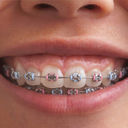
The only difference between metal and clear braces is appearance. They both work the same. Metal braces are made from medical grade quality stainless steel and the clear braces from ceramic. The brace brackets are created through an injection-moulding process with a design that has been refined for comfort and effectiveness. Clear aligners are a completely different method of orthodontically moving teeth with a series of clear plastic mouthguards that are worn 24/7 except for eating and brushing. Clear aligners are typically less effective that braces, used less commonly, and reserved for very simple cases.
Treatment journey
Getting braces fitted doesn’t hurt. As the braces start moving teeth however, tenderness will build over the first 24 hours after fitting, and will be at its worst for the first 3-4 days particularly to eating and chewing. The initial tooth tenderness will improve back to normal after a week.
Most patients are in braces for 12 to 24 months, depending on complexity. Simpler cases can sometimes be completed in six months.
You may notice a slight lisp for the first few days as your mouth adjusts. This settles quickly and most people are speaking normally within a week.
Orthodontic treatment with braces won’t stop you doing what you love. We can fit a mouthguard over your braces for contact sport if needed. Playing musical instruments with braces is rarely an issue, with trumpet players sometimes finding it difficult to achieve their full range of notes.
No. Provided we can reshedule you within 4 weeks of your original appointment, you will stay on track and on time. Please understand that with a busy appointment book, we may not be able to reschedule you to your preferred days and times.
Oral hygiene and care
Healthy gums don’t bleed. So any areas of gum that bleed are a sign these need more attention with brushing.
Swollen gums are typically a reaction poor toothbrushing. Dental plaque builds up around the braces and gums over time. If plaque is not brushed and cleaned, the gums will react by becoming red, swollen and bleedy. Make sure to keep those braces clean!
Be sure to angle your toothbrush both above and below the brackets such that the bristles reach under the wire. We have also given you a packet of Pikster brushes that can completely brush under the wire and are simple to use, we will happlily show you how.
A darker stain is most commonly easily cleanable food/drink stain. Extra care during brushing and your periodic professional dentist cleans will manage this well. A lighter white stain can either be dehydration or natural enamel character/flecking. However, too much plaque and sugar soft drinks/lollies can lead to the first stages of decay, which present as white marks. This must be avoided.
Taking care of your braces is mostly being diligent with your toothbrush. We recommend brushing your teeth and braces twice a day – after breakfast and before going to bed, ensuring that you thoroughly brush all surfaces, particularly the part of tooth between your braces and gums.
This is likely to be a sign that you are not brushing for long enough, or thoroughly enough. Let us know, we’ll get you brushing well.
After orthodontic treatment
Orthodontic treatment with braces won’t stop you doing what you love. We can fit a mouthguard over your braces for contact sport if needed. Playing musical instruments with braces is rarely an issue, with trumpet players sometimes finding it difficult to achieve their full range of notes.
Costs & payment
The amount you can claim back from your health fund varies by fund and level of insurance cover. While we don’t have a HICAPS system to claim on the day, all provided item numbers will allow you to claim from your private health insurance cover.
Every treatment is tailored to the individual, so cost depends on the complexity and length of treatment. We’ll give you a clear, itemised quote at your initial consultation, along with interest-free payment-plan options.
Fees for full braces will range from $10,000 to $14,000 depending on treatment time and complexity. Simple partial braces fees start at $4,000.